Duties we quote
- Water suction and delivery — pump connections, water carts, dust-suppression sprays.
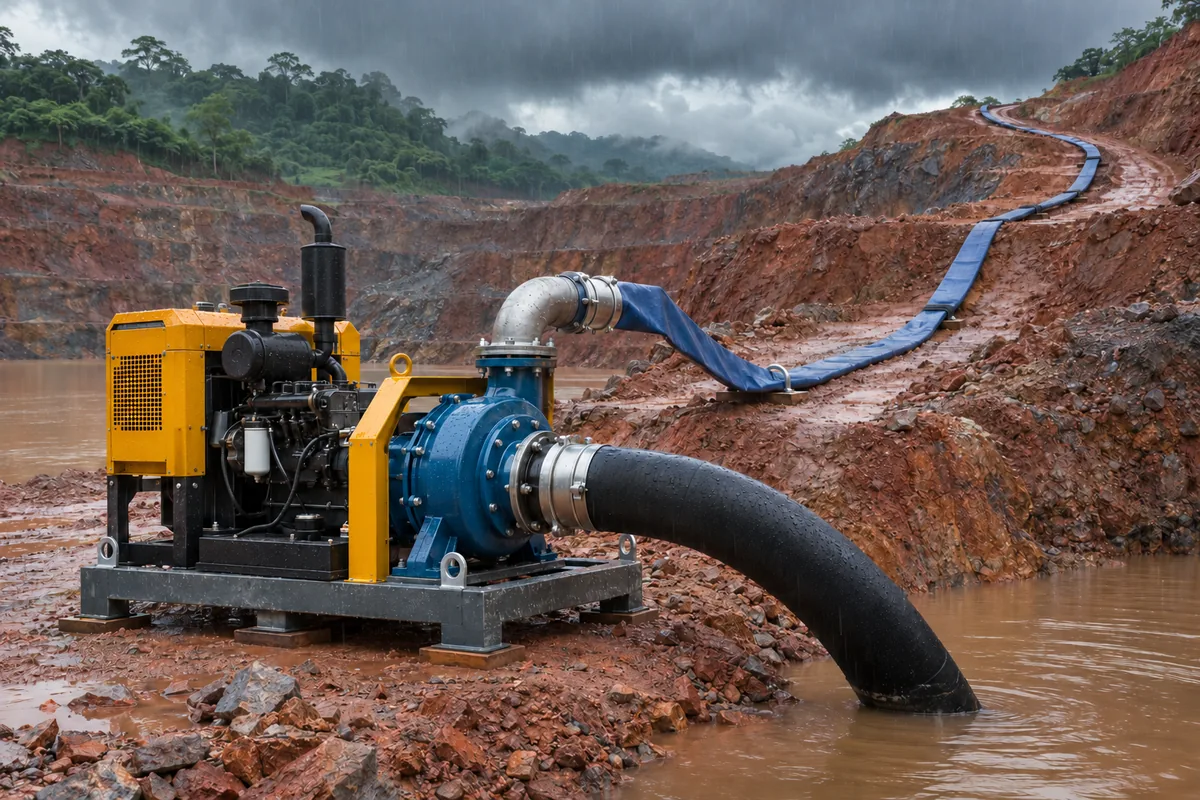
- Dewatering — suction and discharge hoses for pit-sump pumps.
- Compressed air — drill-rig air, workshop air lines, pneumatic tools.
- Material transfer — cement, fly ash and fine powders; abrasion-lined hose for granular materials.
- Oil and fuel transfer — fuel bowsers and lube trucks, with the medium confirmed before quoting.
- Steam and hot water — wash-down and cleaning in plants, where the temperature is specified.
Rain-season dewatering in Ghanaian gold pits
[FACT] The 2017 Tarkwa-Nsuaem municipal profile reports about 1,500 mm mean annual rainfall for that municipality. [INF] For wet-season planning, use your site’s drainage and pump records. Water collects in pit bottoms and on lower benches, and sump pumps run hard through the wet months. The hoses on those pumps work in suction, which demands a helix that resists collapse, and in discharge, where the hose is dragged across rock and re-laid as the sump moves.
Before the rains, we suggest you review: 1. Suction hose condition — a softened or ovalised suction hose cuts pump output long before it fails outright. 2. Discharge runs — sections dragged over broken rock wear along one side; rotating or sleeving them extends life. 3. Couplings — mixed coupling types across pumps slow down change-outs; standardising them is a cheap fix. 4. Spares on site — a short list of the critical suction and discharge assemblies, sized to each pump, avoids improvised repairs mid-season.
Send pump models, hose sizes and lengths and we will quote matching assemblies.
Cement, clinker and port bulk duty
Most of Ghana's cement capacity grinds imported clinker at coastal sites, so material moves by ship unloader, conveyor, pneumatic line and bulk tanker. Fine cement and clinker dust is abrasive inside transfer hoses and at bends. For these duties we look at the inner-tube material, the bend geometry and the coupling style. A requirement can cover bulk tanker discharge hoses or fly-ash and cement transfer lines. More detail is on Cement Plants and Ports, Oil & Gas.
UV and storage in the tropics
Hoses stored outdoors in Ghana's sun and humidity age faster. Covers crack and couplings corrode. Store spare hoses shaded and dry, coil them without kinks, and cap the ends. When you order spares, tell us how long they are likely to sit before use so that we can suggest a suitable cover.
Questions before an enquiry
Useful answers.
Which hose should I use on a pit-sump pump in Ghana's rainy season?
Suction lines need a hose rated for vacuum with a reinforcing helix; discharge lines need abrasion resistance where they cross rock. Send the pump model, sizes and run length and we confirm both in the quotation.
Can you supply industrial hoses with couplings fitted?
Yes. We quote cut lengths or assemblies with couplings, and state the coupling type and hose specification in the quotation.
Do you supply cement and clinker transfer hoses?
Yes, for pneumatic transfer and bulk tanker discharge. Tell us the material, pressure, temperature and bend arrangement so the inner tube and couplings are specified correctly.
Can a mining company in Ghana buy these directly?
Mining companies should check the current Minerals Commission procurement list, which covers hoses and fittings. Plants, port operators and contractors can enquire directly where their applicable procurement rules permit; petroleum-linked purchases need their own local-content check.
You supply Ghana's mines