Where drill-rig hoses work hardest
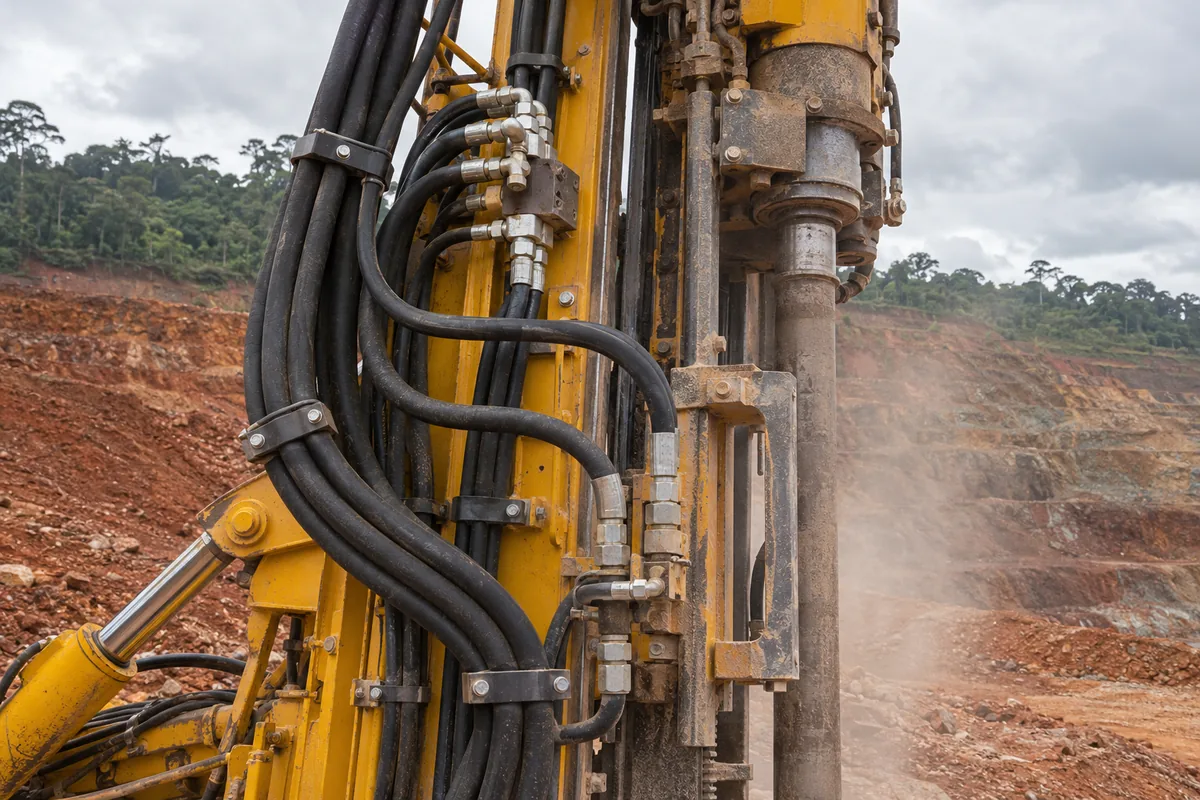
- Feed and rotation circuits — high-pressure lines that flex continuously as the rotation head travels the mast. Hose length, bend radius and clamp positions decide service life.
- Mast raise and pivot cylinders — large cylinders whose hoses move through wide angles every time the rig relocates.
- Hose reels and carriers — where fitted, the hose flexes on every cycle; correct construction and orientation matter.
- Jack and levelling cylinders — low-mounted, mud-exposed and frequently damaged on uneven benches.
- Compressor and air lines — high-volume air feeding the hammer or flushing the hole; temperature and coupling security are the key points.
- Dust-suppression and water lines — low pressure but often neglected; leaks here add to dust and mud around the rig.
Bench conditions to check on the actual site
[INF] At a site with wet laterite benches and dry-season dust, inspect for both mud exposure and abrasive deposits. Use the actual ground and operating conditions to plan the hose review: - Wet months: mud packing around jack cylinders and lower hoses, and water around the drill string. Protective sleeves at contact points and generous clearance help. - Dry months: fine abrasive dust on moving mast hoses, where hoses rub against the mast or each other. Correct clamping and abrasion-resistant covers help.
Heat soak around the compressor and power pack adds a third factor. We check the temperature rating of hoses near those units before proposing a construction.
Building a drill-rig kit from your machine
Send the rig make, model and serial number, the mast and rod configuration, and photos of the main hose runs. If the rig has been rebuilt or modified, tell us; routing on rebuilt rigs often differs from the original parts book. We return a kit list by circuit for you to approve, separating: 1. Mast kit — feed, rotation and mast-cylinder lines 2. Chassis kit — jacks, tracks, steering and pilot lines 3. Air and water kit — compressor, flushing and dust-suppression lines 4. Critical spares — the few positions that stop the rig, held on site
You can send references for drills from makers such as Sandvik and Epiroc, among others. Aftermarket assemblies built to the confirmed reference. Not OEM-genuine parts; no OEM approval is claimed.
Questions before an enquiry
Useful answers.
Which drill-rig hoses should I hold as critical spares in Ghana?
Typically the feed and rotation lines, the mast-raise cylinder lines and the main compressor hoses, because each of them stops the rig. We confirm the list from your rig's serial number and duty.
Can you build kits for older or rebuilt drill rigs?
Yes. Send photos of the actual hose runs and any remaining tags. We confirm each position before quoting, because rebuilt rigs often differ from the parts book.
Do you supply the air hoses as well as hydraulic hoses?
Yes. Air, flushing and water lines can be included in the kit, with the hose type and couplings stated in the quotation.
Can a drilling contractor buy direct?
Contractors can enquire directly where applicable procurement rules and their contract permit. Check the current Minerals Commission list for mining-linked purchases; we also quote qualifying Ghana-incorporated suppliers.
You supply Ghana's mines