
How we build an assembly
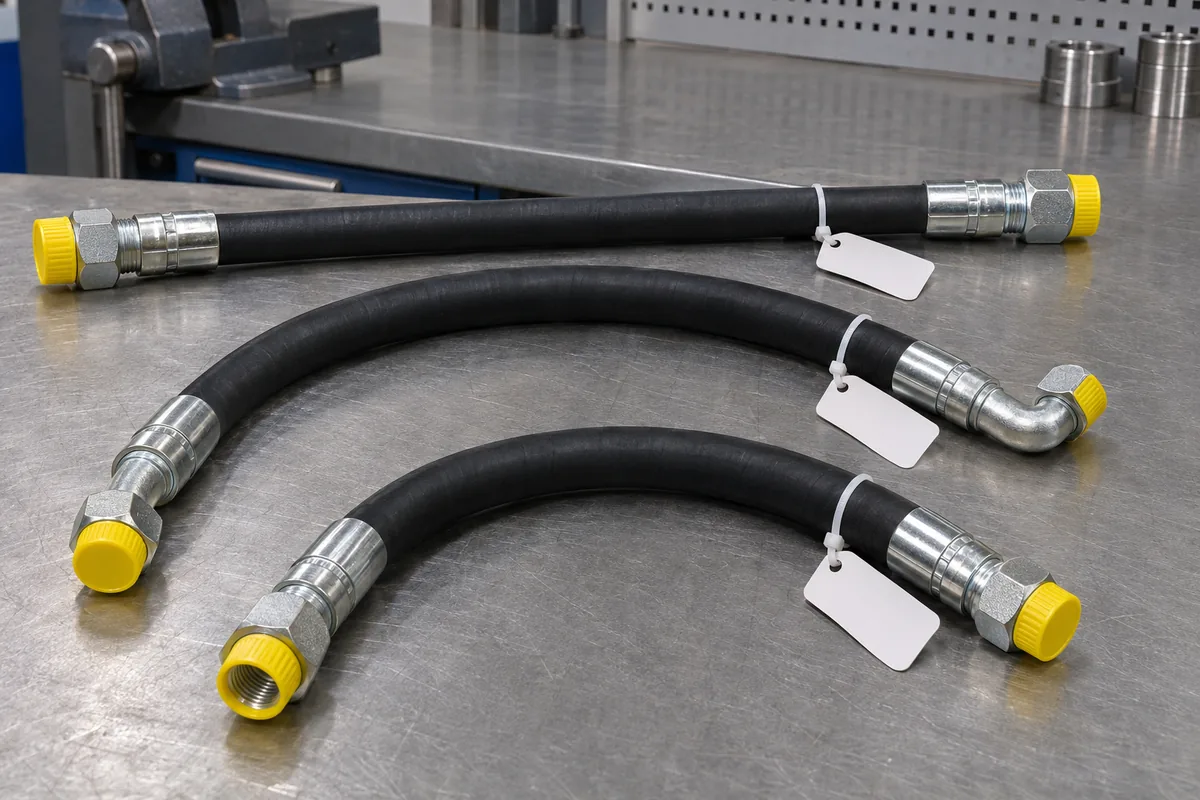
We confirm five things before quoting: the hose construction and standard, the end fittings at both ends, the overall length measured as your team measures it, the orientation (twist angle) between bent fittings, and any protection such as a sleeve or spring guard. Fittings are matched to the hose series so the crimp diameter is correct for that hose. After crimping, assemblies are pressure-tested and tagged. Pressure-test records for the supplied assemblies are provided; other documents are agreed in the quotation.
Assembly risks to review for Ghana duty
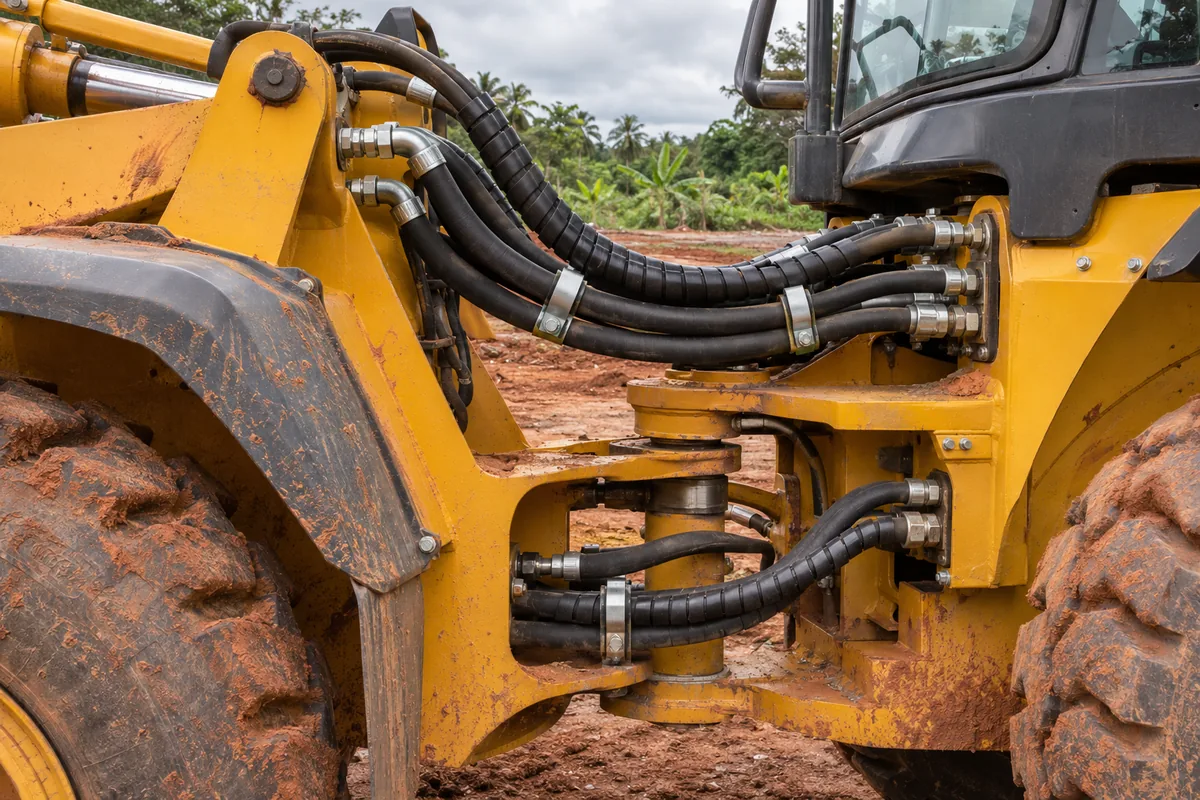
Rain, mud and laterite. [FACT] The 2017 Tarkwa-Nsuaem municipal profile describes March–September rainfall for that municipality. [INF] Use your own site conditions when planning protection. Wet laterite packs around low-mounted hoses on haul trucks, loaders and graders. When it dries it becomes an abrasive paste that wears through covers where a hose touches a frame or another hose. Our answer is routing length and protection: we confirm the length that avoids contact, and we add spiral guards or textile sleeves at known rub points.
Fine dust in the dry months. Where haul roads dry out, fine dust can collect around equipment. Dust is rarely the direct cause of a burst, but it enters the system whenever a line is changed in the field, and it scours seals. Capped and plugged assemblies, delivered with dust caps on every open end, help workshops keep contamination out.
Heat and humidity together. [FACT] The same Tarkwa-Nsuaem profile reports temperatures around 26–30 °C and relative humidity of 70–80 %; these are municipal planning context. [INF] Hoses in engine bays and near hydraulic tanks run much hotter than ambient, so we look at the hose temperature rating, not only pressure. Humid, acidic environments also attack plain-plated fittings; zinc-nickel plated or stainless-steel fittings can be offered where corrosion is the main failure.
Coastal salt air. Port cranes, ship unloaders and cement terminals at Tema and Takoradi face salt spray. Inspect ferrules and nuts for corrosion and confirm the required protection from the actual exposure.
Machine and circuit references for Ghana requirements
Equipment covered by this page includes large mobile machines and fixed plant: - Rigid haul trucks — hoist, steering and brake-cooling circuits; large-bore suction and return lines. - Large hydraulic excavators and face shovels — boom, stick and bucket cylinder hoses, swivel lines, pilot circuits. - Wheel loaders, dozers and graders — articulation steering, blade and ripper circuits, which are among the most mud-exposed positions on any fleet. - Blast-hole and production drills — feed, rotation and high-pressure lines that flex every cycle. See drill-rig kits. - Underground loaders and jumbos — compact routing and fire-resistant cover options. See underground kits. - Fixed plant — grinding-mill lubrication and hydraulic power units, packer cylinders, steel-mill and scrap-shear hydraulics, port crane and unloader circuits.
Machine names are used only to describe the circuits involved. Aftermarket assemblies built to the confirmed reference. Not OEM-genuine parts; no OEM approval is claimed.
What to send from Ghana
- The old hose, or clear photos of both ends with a ruler, and the printing on the hose layline
- The tag or OEM part number, if there is one
- Machine make, model and serial number, and the position of the hose
- Working pressure and fluid if it is fixed plant
- The delivery region and whether you are the importer of record
Questions before an enquiry
Useful answers.
Can you copy an old hose that has no readable markings?
Yes, in most cases. Send photos of both fittings with a measuring tape, the overall length, and the machine and position. We identify the thread and seat and confirm the build in writing before quoting.
Which hose protection suits Ghana's rainy seasons?
For positions exposed to laterite mud, a spiral guard or textile sleeve may be considered at contact points, with routing length checked to avoid rubbing. The choice is written into the quotation per position.
Are these genuine OEM hoses?
No. They are aftermarket assemblies built to the confirmed reference, with the hose standard and fittings stated. No OEM approval is claimed.
Do assemblies arrive capped?
Assemblies are supplied with open ends capped or plugged, which matters in dusty dry-season workshops. Packing details are confirmed in the quotation.
You supply Ghana's mines